Krayin CRM 2.2.6 Stored Template Injection XSS via Web Form Description
A GitHub repository version of this disclosure can be read here: CVE-2026-48543.
| Detail | Information |
|---|---|
| CVE Record | CVE-2026-48543 |
| Severity | 5.1 Medium (CVSS:4.0/AV:N/AC:L/AT:N/PR:L/UI:P/VC:N/VI:N/VA:N/SC:L/SI:L/SA:N) 5.4 Medium (CVSS:3.1/AV:N/AC:L/PR:L/UI:R/S:C/C:L/I:L/A:N) |
| Date Published | 2026-09-24 |
| Software Name | Krayin CRM |
| Affected Version(s) | 0 through 2.2.6 |
| Software Link | https://github.com/krayin/laravel-crm/tree/2.2 |
| Vendor | Webkul |
| Researcher Credits | Aaron Amran Bin Amiruddin (@aaronamran) |
Description
Krayin CRM through 2.2.6 contains a stored client-side template injection vulnerability that allows authenticated attackers to execute arbitrary JavaScript in other users' browsers by injecting Vue.js template expressions into the web form description field. Attackers can craft a web form description containing double-brace template syntax that reaches the Vue template compiler, enabling prototype chain traversal to retrieve the Function constructor and execute attacker-supplied JavaScript in the application origin for every user who views the affected web form.
Proof-of-Concept
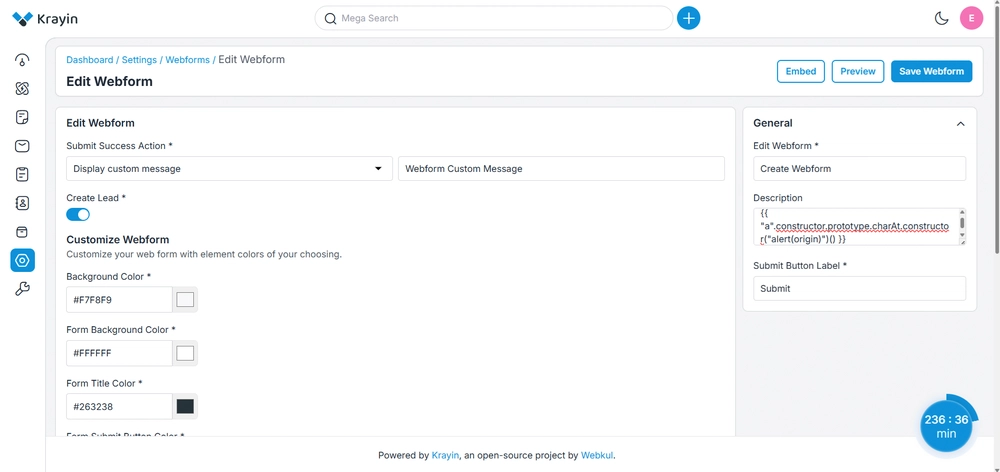
1. On a Krayin instance running a version prior to 2.2.6, navigate to Dashboard > Settings > Webforms > Edit Webforms. Only the Description field requires the payload. For other input fields or dropdowns, enter any valid inputs.
- Description:
{{ "a".constructor.prototype.charAt.constructor("alert(origin)")() }}
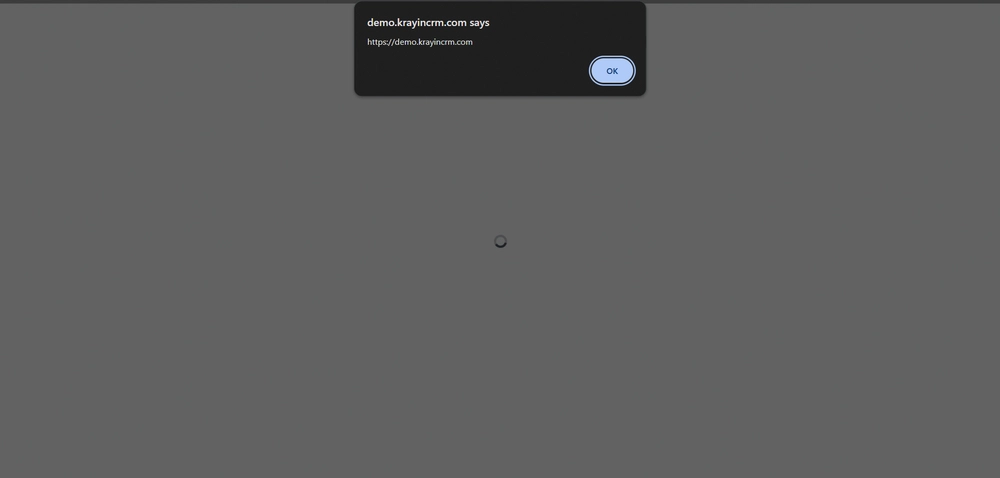
2. Upon viewing the webform, an alert box will popup, indicating a successful stored XSS via CSTI.
Vulnerable Code Section
<p class="mt-2 text-base text-gray-600">{{ $webForm->description }}</p>
Recommended Fix
- To defend against CSTI which can lead to XSS, add a
v-predirective in the<p>element of the code:
<p class="mt-2 text-base text-gray-600" v-pre>{{ $webForm->description }}</p>
Timeline
- 30 March 2026: Initial discovery of a vulnerability in Bagisto v2.1.3 using their Live Demo instance. Sent a full email report to Krayin CRM support team.
- 14 May 2026: Sent initial email disclosure to VulnCheck requesting assistance with vendor reachout process.
- 19 May 2026: VulnCheck replied to my initial email, and requested that I include them to the email thread with Krayin CRM team.
- 22 May 2026: Resent full email report to Krayin CRM support team and included VulnCheck inside.
- 27 May 2026: VulnCheck replied in the email thread to inform the vendor of the 120-day deadline policy and assigned and reserved the CVE ID.
- 30 June 2026: VulnCheck sent an email reminder to the vendor in the email thread looking to make contact with a representative from Krayin CRM team, but so far no replies were received from Krayin CRM team.
- 1 August 2026: VulnCheck resent an email reminder to the vendor due to the absence of replies.
- 28 August 2026: After checking for any code fixes on the current codebase (v2.2.5 at the point in time), I updated VulnCheck that the current codebase has no fix applied yet.
- 24 September 2026: VulnCheck sent me an email that I am allowed to make public disclosure since the deadline has reached. I published my public disclosure in my GitHub repository, and the CVEs were officially published on cve.org.
See you in the next hack.
@aaronamran
September 2026